

How We Represent Your Line in Canada
Signing with a representative is straightforward. What happens afterward determines whether your line sells. This page describes the work itself — where we go, who we see, and what has to happen before a Canadian distributor puts your part numbers on a purchase order. If you are still weighing whether representation is the right model, start with what a manufacturer’s representative is
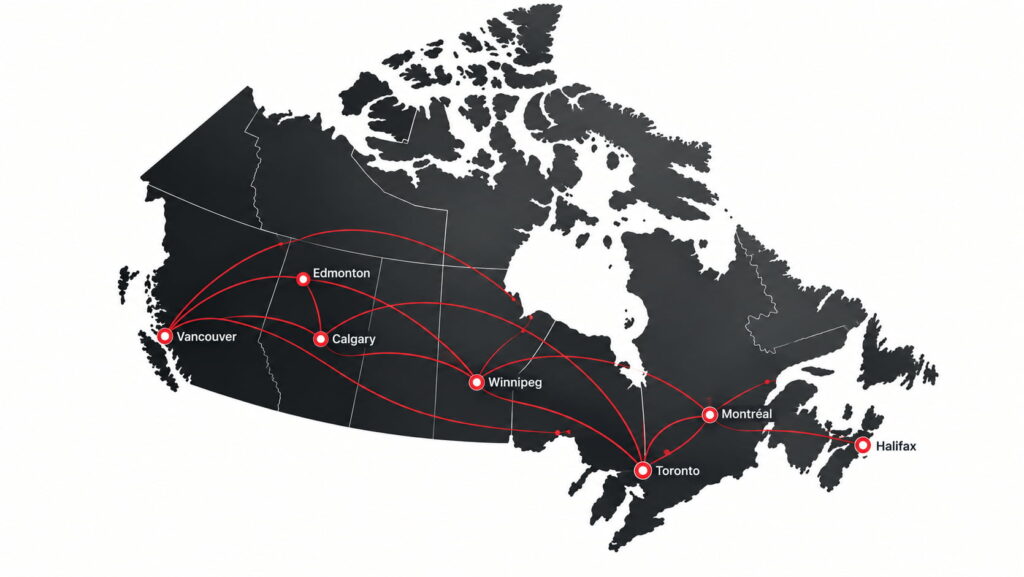
Covering the Canadian Market
Canada is not one market, and the decisions that matter are not made where most people outside the country assume. Quebec is the centre of Canadian parts distribution. Several major distributors and buying groups are Quebec-based.
UAP inc. — parent of NAPA Canada. and Altrom/Auto-Camping — has been headquartered in Montreal for nearly a century. Its heavy-duty division, Traction and its TruckPro banner, operates from Boucherville.
Uni-Select, now under LKQ ownership, has been based in Boucherville for over fifty years.
Entrepot de Montreal 1470 (Monaco group) is headquartered in Montreal.
For a manufacturer outside Canada, this has a practical consequence: the buyers who decide whether your line goes on a national line card are concentrated within about thirty kilometres of each other. Our office is minutes away from them, which means a meeting is a drive rather than a flight.
Ontario holds the head offices of major buying groups, including Modern Sales co-op and Bestbuy Distributors.
Western Canada has its own regional distributors and a different vehicle mix — more light trucks, more heavy-duty, and different seasonal demand patterns.
Atlantic Canada is served through a mix of regional distributors and national accounts, with longer lead times and smaller order volumes.
Training the People Who Actually Sell Your Product
A distributor stocking your line is the beginning, not the result. The people who move product are counter staff and outside sales representatives, and they sell what they know. If a counter person has never heard of your brand, they will recommend the one they can describe.
We deliver product training at the distributor level: what the line covers, where it fits against alternatives, what the technical selling points are, and how to answer the questions a technician will ask. In Quebec, that training happens in French. This is ongoing work, not a launch event. Distributor staff turn over, and product lines evolve.
Trade Shows and Industry Presence
We represent your line at Canadian industry events — regional buying group shows and distributor open houses — as well as at AAPEX, which draws distributors, buying groups and manufacturers from across North America and beyond — including much of the Canadian buying community.
These are not branding exercises. Buying decisions and line reviews genuinely happen in these rooms, and a manufacturer without local representation is a name on a booth rather than a relationship.
How a Line Launch Unfolds
Assessment. We look at where your line fits against what Canadian distributors already carry, and identify the accounts most likely to be a match. Some lines are ready as they are; others need adjustment first. We tell you which before we start.
Introductions. We present the line to those accounts, timed to their line review cycles rather than to our calendar.
Evaluation. Distributors request samples, pricing and application data. They compare your line against their incumbent and against their own gaps. This is the stage that takes as long as it takes.
Catalogue work, in parallel. Part numbers and applications (ACES/PIES data) need to be loaded before the first order ships, not after. Starting this early is one of the few things that genuinely shortens the path.
First placements. Opening orders, followed by training for the counter and outside sales staff at the accounts that have committed.
Territory development. Coverage widens from the initial accounts into adjacent ones, and sell-through data begins to show which applications and regions perform.
On timing: Canadian distributors review their line cards on set cycles, and those cycles vary by distributor, by category and by how well an incumbent is performing. A line entering a category under review moves quickly; the same line arriving a month later waits for the next window. We will give you a realistic read once we know your line and the accounts involved — and we would rather give you that read than a number that sounds good.
When Representation Is Not the Right Fit
We would rather decline a line than take it on and disappoint both parties. It does not work when:
- Pricing is not competitive. No relationship closes that gap.
- You need inventory held and orders shipped. That is a distributor’s role.
- You need placement on a fixed deadline. Distributor review cycles set the pace, and they do not compress.
- Technical questions cannot be answered. Counter staff and technicians need reliable answers, and without them the line loses credibility quickly.
- There is no catalogue data. Without it, the line cannot be sold at the counter.